What Is Predictive Analytics? A Guide to Its Definition, Benefits, Challenges, & Examples

Predictive analytics helps organizations make more informed decisions, optimize operations, and gain a competitive edge in their industry. Whether it’s forecasting customer behavior, improving risk management, or enhancing marketing strategies, predictive analytics provides valuable insights that drive smarter, data-driven decisions.
What is Predictive Analytics?
Historically, analytics has gone through three distinct phases. Understanding where we are today helps explain what predictive analytics is and why it’s so important.
The first phase is traditional BI. This is where most organizations started. Traditional BI is defined by dashboards, reports, and retrospective analysis. One key challenge with traditional BI is that insights often arrive after exporting data into a report. This runs the risk of spending time manually backtracking and updating data, or data becoming stale the moment a report is generated.
Phase two is predictive analytics. This was a big step forward. Defined by machine learning tools and data science pipelines that live outside core applications. Getting predictions into production required heavy data engineering effort where insights often remained siloed in separate tools that users didn’t want to open.
Phase three is converged analytics platforms. In this third phase, intelligence isn’t separated the way it was in the previous phase. Instead, it’s embedded across your platform, offering predictions delivered in the natural workflow where users make decisions.
This brings us to predictive analytics.
Predictive analytics combines data mining, statistical modeling, machine learning algorithms, artificial intelligence, and other advanced techniques to predict future outcomes. In essence, predictive analytics is the pinnacle of all three phases, taking large data sets (especially historical data) and applies various models to forecast future trends, events, or results. In key industries like healthcare and financial services, predictive analytics plays a crucial role in decision-making, optimization, and uncovering actionable insights.
How Does Predictive Analytics Work?
Predictive analytics uses historical data, machine learning, and artificial intelligence to forecast what will happen in the future. This historical data is fed into a mathematical model that considers key trends and patterns in the data. The model is then applied to current data to predict what will happen next. Models and algorithms vary, but the general process for how predictive analytics works follows these steps:
- Data collection: Accumulate relevant historical and current data.
- Data preprocessing: Clean, standardize, and prepare the data for analysis.
- Feature engineering: Create or select impactful variables for modeling.
- Model selection/building: Choose and train models (statistical or machine learning).
- Model evaluation/validation: Test reliability using unseen data and refine as needed.
- Deployment: Embed model into business systems to produce live predictions.
- Monitoring/refinement: Track performance and update models as conditions and data change.
Using the information from predictive analytics can help companies identify actions to affect positive operational changes. Analysts can use predictive analytics to foresee if a change will help them reduce risks, improve operations, and/or increase revenue. At its heart, predictive analytics answers the question, “What is most likely to happen based on my current data, and what can I do to change that outcome?”
Predictive Analytics vs. Prescriptive Analytics
To boil these two forward-looking methods down to their basics, prescriptive analytics is the next phase beyond predictive analytics. Predictive analytics forecasts future outcomes to answer “What will happen?” Prescriptive analytics takes this and also recommends what action should be taken to achieve optimal outcomes — answering “What should we do?”
Types of Predictive Analytics
Predictive analytics models typically fall under one of the following categories: Classification models, clustering models, forecast models, and time series models. There are also different types of predictive analytics algorithms, such as Random Forest, Generalized Linear Model, Generalized Boosted Model, K-means, Prophet, XGBoost, Temporal Fusion Transformer, and AutoML.
Learn more about types of predictive analytics models and algorithms here.
The Definitive Guide to Predictive Analytics
Download NowWhy Predictive Analytics is Important
Predictive analytics is critical for modern businesses because it enables teams to anticipate future trends, behaviors, and outcomes, allowing them to make informed decisions and stay competitive. By leveraging historical data and advanced algorithms, predictive analytics helps businessesoptimize operations, reduce risks, and improve overall efficiency. It plays a crucial role in various industries, such as healthcare, finance, and retail, where predicting customer behavior, market trends, or potential risks can lead to significant competitive advantages.
How is AI Being Used in Predictive Analytics?
For example, our Logi Symphony’s AI module is a chat-based model trained on your specific data to provide more accurate, intelligent, and tailored responses about performance. Because it’s a part of Logi Symphony, Logi Symphony AI can also be quickly embedded within applications for real-time (and grounded) insights of its connected dashboards and applications.
Benefits of Predictive Analytics
The benefits of predictive analytics are vast, offering organizations the ability to transform raw data into valuable insights that drive success. By enabling improved decision-making, predictive analytics helps businesses make more accurate and timely choices. It also reduces risks by identifying potential issues before they arise and enhances operational efficiency by optimizing resources and streamlining processes. Additionally, predictive analytics can personalize customer interactions, leading to better experiences and ultimately contributing to increased revenue through optimized pricing and marketing strategies.
Additional business benefits of predictive analytics also include:
- Improved Decision-Making: Enables data-driven decisions that are more accurate and timely.
- Risk Reduction: Helps identify potential risks before they materialize, facilitating more proactive measures.
- Operational Efficiency: Streamlines operations by predicting demand, optimizing resources, and improving processes.
- Enhanced Customer Experience: Personalizes customer interactions by predicting preferences and behaviors.
- Increased Revenue: Identifies growth opportunities and optimizes pricing and marketing strategies.
Key Challenges/Downsides of Predictive Analytics
While predictive analytics offers substantial benefits, it also presents several challenges that organizations must consider and navigate to be successful. These challenges include:
- Data Quality: Poor data quality can lead to inaccurate predictions, making data cleansing essential.
- Complexity: Building and maintaining predictive models requires specialized skills and resources.
- Integration: Incorporating predictive analytics into existing systems and workflows can be difficult.
- Scalability: As data volumes grow, maintaining predictive model efficiency and accuracy becomes challenging.
- Ethical Considerations: Predictive analytics must be used responsibly to avoid biases and ensure fair outcomes.
Learn more about the common challenges of predictive analytics solutions here.
Best Practices for Predictive Analytics
To fully leverage the power of predictive analytics, organizations should adhere to best practices that enhance effectiveness and sustainability. To maximize the effectiveness of your predictive analytics, our analysts recommend following these best practices:
- Define Clear Objectives: Start with a clear understanding of what you want to achieve with predictive analytics.
- Ensure Data Quality: Prioritize data accuracy and completeness to improve model reliability.
- Select the Right Tools: Choose predictive analytics tools that align with your business needs and technical capabilities.
- Collaborate Across Teams: Involve stakeholders from various departments to validate that models address real business challenges.
- Regularly Update Models: Continuously refine and update predictive models to adapt to changing data and conditions.
- Monitor Performance: Track the performance of predictive models to ensure they are delivering the expected outcomes.
How Can You Use Predictive Analytics? Intro to Tools & Methods
Predictive analytics tools are essential for businesses seeking to anticipate trends, behaviors, and outcomes, enabling proactive decision-making. Popular predictive analytics tools include SAS Advanced Analytics, IBM SPSS Statistics, Logi Symphony, and Python’s scikit-learn library, each offering unique capabilities for data analysis, modeling, and visualization.
Some examples of methods used by predictive analytics software are:
Regression Analysis
Regression analysis, including linear regression, is a statistical technique used to understand relationships within a relatively simple data set. For example, it can help in predicting credit scores or pricing strategies based on previous trends.
Time Series Analysis
Time series analysis is the examination of sequential data points measured at successive time intervals. This analysis is used to forecast future events such as stock prices or supply chain demands using current data.
Classification Analysis
Classification analysis can be used in healthcare or retail sectors to categorize data into predefined classes. Machine learning algorithms like decision trees and neural networks may be applied here.
Cluster Analysis
Cluster analysis helps in big data environments by grouping data with similar characteristics. This is vital in market segmentation, pattern recognition, and even fraud detection.
Ensemble Methods
Ensemble methods combine multiple machine learning models to achieve more accurate predictions. This approach is particularly useful in credit risk assessment and other complex analyses.
Anomaly Detection
Anomaly detection identifies unusual patterns that do not conform to expected behavior. In industries like financial services, this is key for fraud detection and equipment failure prediction.
Examples of Predictive Analytics in Business Intelligence
For many companies, predictive analytics is nothing new. However, it is being increasingly used by a wider range of industries than ever before to improve everyday business operations and achieve a competitive differentiation. This can take a number of different forms, so let’s look at some examples by industry:
Retailers and Pricing
Predictive analytics has been a game-changer for the retail sector. From predictive modeling for optimal pricing to real-time marketing campaigns, retailers use this tool for a competitive edge.
By analyzing large data sets like historical sales data, market trends, and customer behavior, retailers can deploy predictive models to determine the ideal pricing for various products. These models take into account retail KPIs such as sales growth, inventory turnover, and customer retention rates to ensure that pricing aligns with overall business goals. The integration of predictive analytics with retail analytics provides a more comprehensive understanding of market dynamics, enabling real-time adjustments to pricing in response to fluctuating demand or competitive pressures.
Predictive analytics also allows retailers to create personalized marketing campaigns and forecast inventory needs, ensuring that the right products are available at the right time and price. Once again, KPIs help to measure the effectiveness of these strategies, allowing continuous optimization and alignment with business objectives.
Example: Identify customers who are likely to abandon a service or product
Consider a yoga studio that has implemented a predictive analytics model. The system may identify that Jane will most likely not renew her membership and suggest an incentive that is likely to prompt renewal based on historical data. The next time Jane comes into the studio, the system can remind the membership relations staff to offer her an incentive or talk with her about continuing her membership. This way, predictive analytics can be used to remedy customer churn before it takes place.
Marketing Campaigns
In the ever-competitive world of marketing, predictive analytics has revolutionized the way companies connect with their customers. By leveraging machine-learning algorithms, data analysis, and a deep understanding of consumer behavior, businesses can create campaigns that are not only more engaging but also more efficient and cost-effective.
Here’s how predictive analytics can influence marketing:
- Personalized Targeting: Using historical data and pattern recognition, companies can tailor their marketing materials to individual preferences so each campaign resonates with its intended audience.
- Optimizing Budget Allocation: By predicting which channels and strategies are most likely to yield positive outcomes, companies can allocate their marketing budgets more effectively, reducing waste and improving return on investment.
- Real-Time Engagement: Predictive analytics enables businesses to engage with customers in real-time, offering special deals or information precisely when they’re most likely to make a purchase.
- Forecasting Future Trends: By analyzing large data sets, predictive analytics helps in understanding future trends in consumer behavior so businesses can stay ahead of the curve and adapt their marketing strategies to align with shifting consumer needs and desires.
- Enhancing Customer Retention: Predictive models can identify customers at risk of churning and prompt real-time initiatives to retain them (often executed through special offers or personalized communication).
- Improving Content Strategy: Predictive analytics can analyze which types of content resonate best with different segments of the audience, crafting content that is more engaging and relevant.
Example: Send marketing campaigns to customers who are most likely to buy
If your business only has a $5,000 budget for an upsell marketing campaign and you have three million customers, you obviously can’t extend a 10 percent discount to each customer. Predictive analytics and business intelligence can help forecast which customers have the highest probability of buying your product, and then you can send the coupon to only those users to optimize revenue.
Customer Service
In today’s customer-centric business landscape, predictive analytics has been instrumental in transforming customer service and experience. Businesses are able to predict customer needs and preferences, providing support even before issues arise. For instance, predictive models using historical data can identify potential problems in products or services, allowing businesses to proactively address issues before they affect customers.
Real-time predictive analytics can also guide customer service reps to provide more personalized solutions based on an individual’s purchase history or past interactions with the company. This proactive and tailored approach not only enhances the customer experience, but also builds loyalty and trust. By analyzing large datasets, recognizing patterns, and employing predictive analytics models, companies are taking customer service to new heights, ensuring that customers are always met with timely, relevant, and effective support.
Example: Improve customer service by planning appropriately
For example, consider a hotel chain that wants to predict how many customers will stay in a certain location this weekend. Predictive analytics based on historical seasonality data enables them to have enough staff and resources to handle demand, and allocate them to the highest-priority service areas.
Healthcare Industry
In the healthcare industry, predictive analytics models are used for patient care optimization, early disease detection, and logistics planning. By employing algorithms that analyze vast amounts of data, healthcare providers are able to forecast patient needs and provide personalized treatment plans, guided by specific healthcare KPIs.
These predictive models not only contribute to improved patient outcomes but also optimize resource allocation within hospitals and medical facilities. Healthcare analytics focuses on actionable insights that drive decision-making, including patient satisfaction, treatment efficacy, and operational efficiency.
Additionally, predictive analytics supports decision-making in treatment plans, supply chain management, and even administrative workflow, so the healthcare industry operates with maximum efficiency. From predicting disease outbreaks to tailoring patient care based, predictive analytics in the healthcare industry stands as a beacon of innovation, demonstrating the enormous potential of data-driven insights in transforming lives.
Financial Services and Credit Scoring
Financial institutions use predictive analytics for credit risk evaluation, fraud detection, investment planning, and more. By leveraging vast amounts of data, including transaction history, credit utilization, and repayment behavior, financial institutions can develop robust predictive models to assess an individual’s creditworthiness.
These predictive algorithms also provide a more nuanced understanding of credit risk and can even predict future financial behavior. They enable a dynamic response to changes in a customer’s financial situation, allowing for more tailored lending and risk management strategies.
In addition to credit scoring, predictive analytics is used to detect fraudulent activities, optimize investment strategies, and enhance customer engagement through personalized offerings. Financial services companies that harness the power of predictive analytics not only improve decision-making, but also drive innovation in product development, pricing strategies, and customer experience.
| Industry | Predictive Analytics Examples | Benefit |
| Healthcare | Predicting patient readmission risk (e.g. for heart failure, diabetes, pneumonia) and forecasting treatment outcomes. | Helps allocate resources effectively, reduce readmissions, and personalize patient care. |
| Supply Chain | Demand & inventory forecasting, route optimization, and supply-chain risk forecasting. | Reduces holding costs, prevents stockouts, optimizes delivery routes, and mitigates disruptions. |
| Marketing | Identifying buying behavior, customer segmentation, next-best-action, and predicting customer lifetime value. | Enables targeted campaigns, improves ROI, and tailors messaging for higher engagement and conversions. |
| Retail | Predictive marketing and inventory (avoiding overstock/stockouts), cross-/up-selling, and behavioral pattern mining. | Enhances sales, ensures optimal stock levels, and improves customer experience and operational efficiency. |
| Finance | Forecasting cash flow, detecting fraud in real-time, and predicting late payments. | Improves financial planning, reduces fraud/losses, and enhances liquidity and risk management. |
| Education | Predicting student outcomes (e.g. dropout risk) and optimizing interventions for at-risk students. | Enables proactive support to improve retention and student success. |
| HR | Predicting employee turnover, success in recruitment, and performance suitability. | Improves retention, aids workforce planning, and enhances hiring accuracy. |
| Real Estate | Predicting commute times for homebuyers using location data. | Helps buyers make informed decisions, improves marketing personalization, and streamlines property search. |
How to Incorporate Predictive Analytics into Your Workflows?
Accurate and effective predictive analytics procedures and tools take some upfront work to set up. Done right, predictive analytics helps people who understand there is a business problem to be solved, data that needs to be prepped for analysis, models that need to be built and refined, and leadership to put the predictions into action for positive outcomes.
Any successful predictive analytics project should involve these steps:
- Define the Business Problem: Identify the issue, like reducing equipment failures or improving metrics.
- Data Collection: Collect relevant data, considering factors like data quality, type of data, and size.
- Data Analysis: Data scientists and data analysts apply statistical techniques, machine learning algorithms, and deep learning to analyze the data.
- Model and Predict: Build predictive models using regression models, neural networks, and other analytics models. Regular updates ensure accuracy.
- Implement: Put actionable insights from the model into real-time workflows.
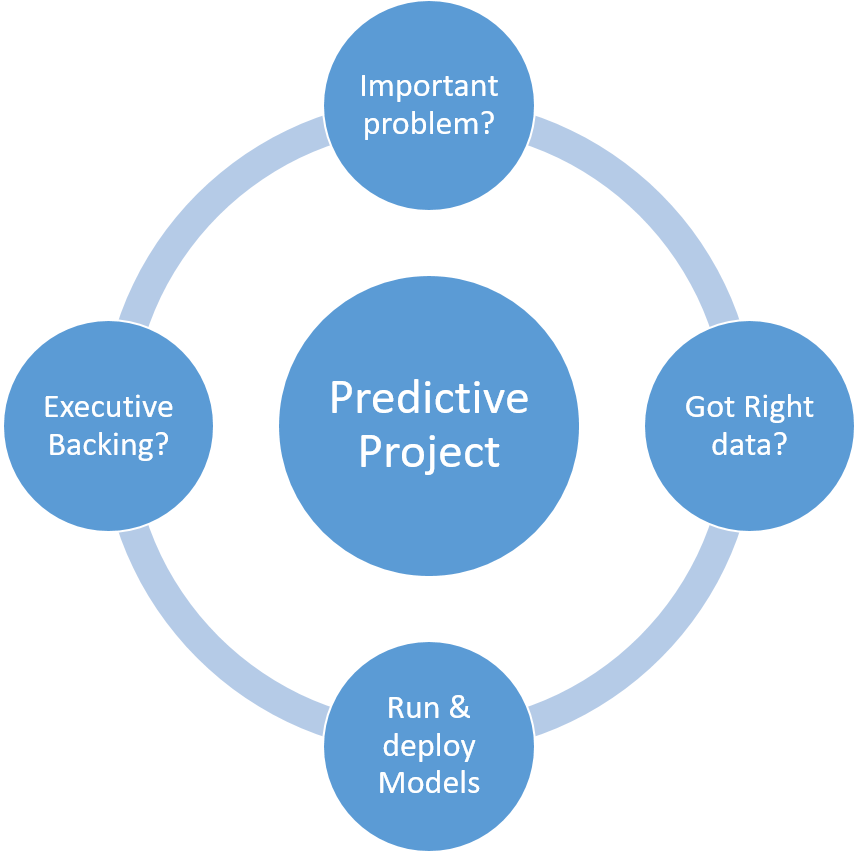
1. Identify what you want to know based on past data
What questions do you want to answer? What are some of the important business decisions you’ll make with the insight? Knowing this is a crucial first step to applying predictive analysis.
2. Consider if you have the data to answer those questions
Is your operational system capturing the required data? How clean is it? How far back do you have this data, and is that enough time to learn any predictive patterns?
3. Train the system to learn from your data
When building your model, start by training the system to learn from data (e.g. your predictive analytics model might look at historical data like click action). By establishing the right controls and algorithms, you can train your system to look at how many people who clicked on a certain link bought a particular product and correlate that data into predictions about future customer actions.
Your predictive analytics model should eventually be able to identify patterns and/or trends about your customers and their behaviors. You could also run one or more algorithms and pick the one that works best for your data, or opt to pick an ensemble of these algorithms.
4. Schedule your modules
Predictive analytics modules can work as often as you need. For example, if you receive new customer data every Tuesday, you can automatically set the system to upload that data when it comes in.
Another key component is to regularly retrain the learning module. Trends and patterns will inevitably fluctuate based on the time of year, what activities your business has underway, and other factors. Schedule a timeline (maybe once a month or once a quarter) to regularly retrain your predictive analytics learning module to update the information.
Can Predictive Analytics Influence Business Outcomes?
Predictive analytics is not just a theoretical concept — it leads to real, tangible business outcomes.
- Business Intelligence Integration: By combining predictive analysis with business intelligence, companies create data-driven strategies.
- Supply Chain Optimization: Predictive analytics provides insights into supply chain needs and optimization possibilities.
- Customer Engagement: From targeted marketing campaigns to personalized customer experiences, predictive analytics can create a competitive edge.
- Decision-Making and Automation: Predictive analytics allows better decision-making and automation in various business initiatives.
How Logi Uses Predictive Analytics to Enhance Business Outcomes
All companies can benefit from using predictive analytics to gather data and predict next actions based on historical behavior. Logi Symphony and Logi Symphony AI leverage advanced predictive analytics to inform decisions that impact your business’s bottom line and influence results.
Not only does Logi Symphony AI enable chat-like interactions with your data to make it more intuitive than ever to perform analysis, but the analysis itself is supercharged by predictive analytics features. With one-click forecasting, advanced pre-built formulas, context-aware insights, streamlined processes, support for custom models, and more, Logi Symphony upgrades your predictive analytics and business intelligence to the AI age.
If you’re ready to learn more about predictive analytics, tune into our on-demand webinar on how to embed predictive analytics into your application.
How to Embed Predictive Analytics into Your Application
Watch Now